Introduction
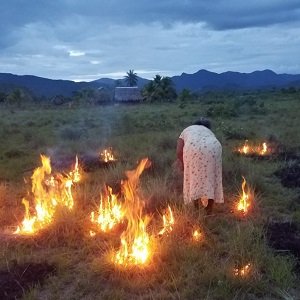
Fire is governed by governments, non-governmental organisations, and communities. It can be influenced by regulations, economic policies, development projects, community agreements and customary norms. Most often, state governance has suppressed, rather than supported, controlled human fire use, with implications for livelihoods, culture, and biodiversity.
The Fire Governance Working Group aims to stimulate discussion about how fire is managed and governed across the world. We provide a space for Centre students and staff to present their ideas and work, to explore commonalities and differences, and to challenge current thinking and paradigms of governance. Themes we are exploring and developing for a joint publication include: the legacies of colonialism in anti-fire regulations and narratives; the indirect effects of economic policies, land tenure reforms, and infrastructural development on fire; and the interactions between different types of fire governance.
The Group is open to all Centre members and affiliates. Please contact Cathy Smith (c.smith@rhul.ac.uk) for more information.
Events
Trade-offs and synergies in multi-level fire governance
Online research workshop, 29 November 2023
People around the world use fire to support small-scale livelihood and cultural practices. In many countries over the past centuries, colonial and post-colonial states have suppressed burning activities, but in recent decades there has been growing interest among state agencies in partnering with fire users for land management. Such engagements are taking place both in countries where fire use is widespread, and in places where fire practices were lost but people now seek to reconnect with fire.
In this online research workshop, we heard how these partnerships are playing out in different contexts and considered how local aspirations and needs sit alongside, or trade off against, national and international agendas related to climate, wildfire mitigation, and ecosystem management. Researchers and practitioners with experience and expertise from around the world shared insights about trade-offs and synergies in multi-level fire governance.
Royal Geographical Society Conference session: ‘Governing fire across spatial boundaries’
In-person session followed by hybrid session, 1 September 2023
In the context of climate change, landscape fires are increasingly visible in the media and of research interest. A burgeoning literature explores social dimensions of fire, including the impacts and mitigation of wildfire, and the role of controlled fire use within rural livelihoods and land management.
State and non-state organisations are increasingly concerned with fire’s governance. For example, in recent years fire has been implicated within greenhouse gas abatement schemes, with payments to smallholders and Indigenous communities either to exclude fire from their lands, or for controlled burning to mitigate emissions from wildfires. Fire governance by state and non-state agencies often overlooks existing social norms and rules that govern fire locally. In many parts of the world, there are thus multiple, interacting forms of fire governance, related to overlapping jurisdictional boundaries and different forms of land tenure. In these two sessions we considered the ways in which fire’s governance is shaped by spatial boundaries at multiple scales.
Session chairs: Cathy Smith, Jay Mistry and Kayla De Freitas (Royal Holloway, University of London), Kapil Yadav (King’s College London).
Leverhulme Centre workshop: Pastoralism and fire in Africa
Online workshop, 4 October 2022
Fire is important within extensive pastoral livelihoods in Africa, being used to maintain rangelands for livestock by suppressing woody growth, bringing up fresh forage, and suppressing livestock pests. Livestock grazing also affects fire regimes by removing fuel from the landscape. Yet pastoral livelihoods are changing and pastoral fire use is declining. In this workshop we discussed these changes, and the implications for pastoral livelihoods, ecologies and fire regimes.
Speakers: Pablo Manzano Baena (University of Helsinki), Sally Archibald (University of the Witwatersrand) and Maike Petersen (University of Heidelberg).