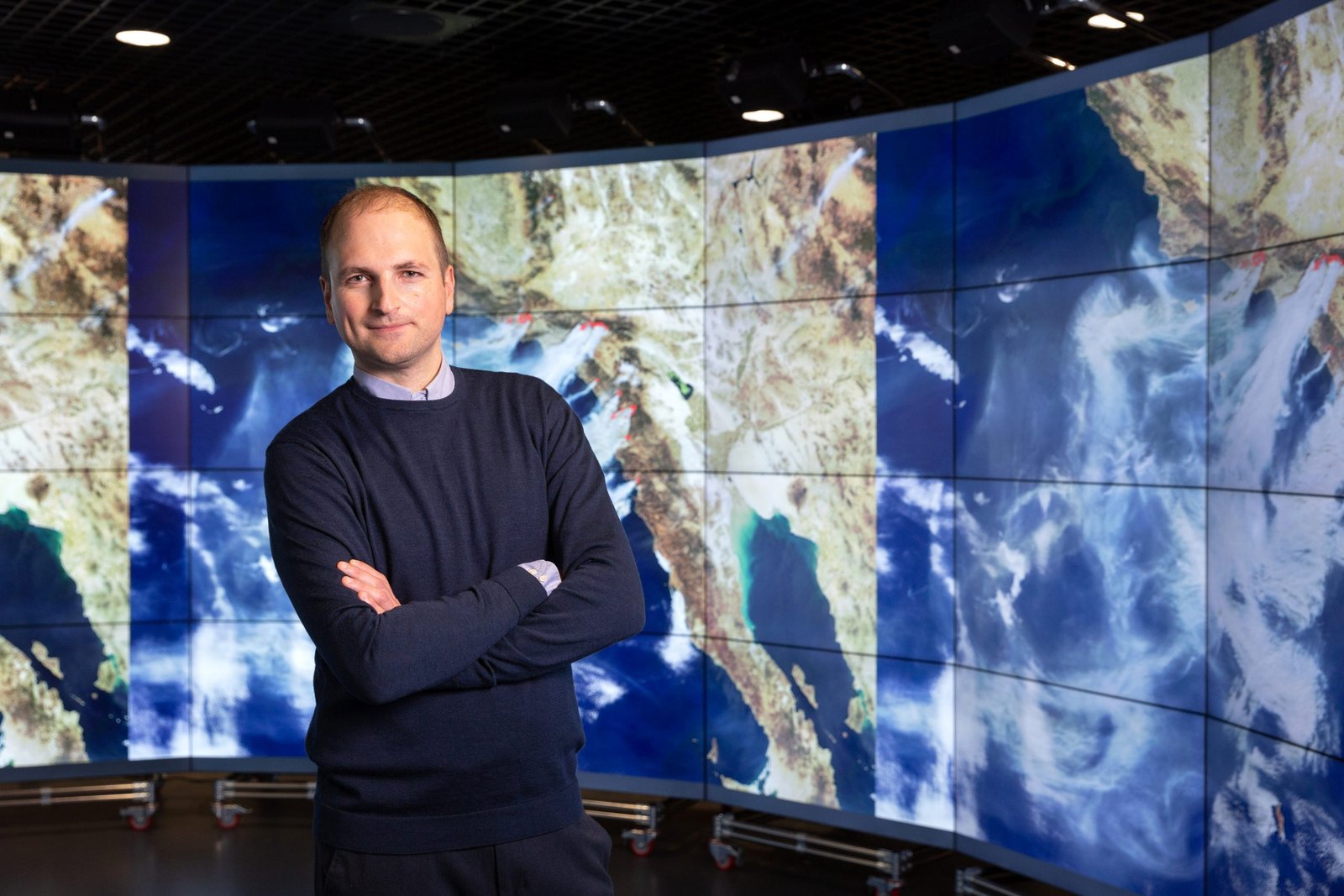
Dr Apostolos Voulgarakis is an Associate Director, and Founding Director, of the Leverhulme Centre for Wildfires, Environment and Society. He is Associate Professor at the Technical University of Crete and remains a part-time Reader at Imperial within the Department of Physics, in the Space and Atmospheric Physics Group. Our Centre Director, Prof. Colin Prentice, asked Dr Voulgarakis a few questions about wildfire research and his vision for the Centre.
Colin:
How did you get interested in wildfires?
Apostolos:
A very early memory from my childhood was a big fire that was raging on the
mountains that I could see at night from my balcony in Crete, it was a proper inferno.
I felt it was very haunting and scary, but at the same time very intriguing. Many
years later, during my PhD in Cambridge, I was studying how different factors influence
the variability of atmospheric composition, of things like carbon monoxide,
ozone and aerosols. One of the factors I decided to study was fire emissions. From
then my activities grew and grew around wildfire and I started working on global
wildfire modelling. You could say the crescendo of all this, at least so far, has
been the conception and materialisation of the Leverhulme Centre for Wildfires,
Environment and Society.
Colin:
Obviously you got into earth system modelling recognising that there were these
connections in different parts of the earth system. So, what do you think about
the current state of wildfire models in earth system models?
Apostolos:
Very simply I would say fire is one of the most poorly represented components
of the earth system. Often, it’s absent, and when we do have it, it’s typically
in a quite limited fashion. The realisation that wildfire can matter for the
earth system is a recent thing, and so global wildfire modelling is in its
infancy. Now we are starting to see efforts to address this, for example by
integrating global wildfire models in earth system models, and The Fire
Modeling Intercomparison Project. However, this showed us that there is still a
long way to go until these models are fit for purpose.
“fire is one of the most poorly represented components of the earth system”
Colin:
What do you think needs doing? How shall we do better?
Apostolos:
There are many fronts that I think we should be working on, such as emissions
and ignitions, but if I were to isolate two, firstly from the physical side, it
would be to incorporate peat fires into earth system models. Peatlands are
organic soils which can burn. They contain huge amounts of carbon that has been
trapped and stored for a long time, so when they burn, they can emit a lot of
CO2 and harmful pollutants into the atmosphere. It’s a timebomb,
especially now permafrost is thawing which can reveal exposed peat. In most
models, we don’t have any inclusion of peatland burning capabilities, but we do
have new information from the lab and from the field. For example, one of the
pioneering labs is here at Imperial, Hazelab, run by our colleague Prof.
Guillermo Rein, who is also part of the Leverhulme Centre for Wildfires. So, we
are getting new information on how those peatlands can burn, and what they emit,
which is a great chance for us to incorporate this information into our earth
system models.
The second other
major axis of development is human influences, especially when it comes to
ignitions and suppressions of wildfires. We almost don’t have a clue on how to
include humans in wildfire components of earth system models. We’ve tried
population and a few other things, but it doesn’t work. It’s a much more
complex system. But, through sitting down with a range of social scientists,
working for example on agriculture, insurance and with local communities, which
is what we are doing with the Centre, I think we can catalyse developments to
improve earth system model representation of wildfire from the human
perspective.
Colin:
Let’s suppose that we can make a much better, more comprehensive earth system
model, that even takes some account of the cultural differences between the way
the fire is used and so on. Let’s suppose we can do this. Is this actually
useful, and if so, who is going to use it?
Apostolos:
Fire emits a range of different constituents into the atmosphere, including
carbon dioxide and aerosols, which can be active in the atmosphere and
influence climate. Not just global temperatures, but regional temperatures,
winds, humidity and precipitation can be affected in ways that we have no clue
about because we haven’t studied those things, because typically we don’t have
this capability. So, climate modelers who want to study such interactions and feedbacks
would benefit from improved models, but also scientists looking at other
components of the earth system – atmospheric chemistry, ocean dynamics, the
biosphere – will benefit too. Outside of the earth system modelling community,
having better global wildfire predictions, climate projections and air quality
estimates for the future will be useful, for example, for people who work in
insurance, agricultural policy, forestry, and various international
environmental agreements. They can all use better predictions of what fire
might be doing in different parts of the world in the future.
Colin:
What timescale of future are you thinking of?
Apostolos:
We can try to make predictions for a variety of timescales, ranging from
weekly, to seasonal, to decadal to even centennial timescales. There are
different stakeholders who are interested in different timescales, and there is
different skill or accuracy of those predictions, depending on the time
horizon. For example, by knowing the meteorological situation right now, we can
make fairly good predictions on the fire risk on a weekly basis. When it comes
to making predictions for decades or centuries to come, of course that becomes
much more challenging, but we hope to build that knowledge over the coming
years within the Centre.
Colin:
Let me press you a bit more about long-term prediction. We recognise that the
human drivers of fire regimes are different in different countries, and even in
different regions within countries, Australia for example. Given that cultures
and institutions are involved, is there any sense in trying to predict 50 years
ahead, because we don’t know how those institutions are going to change?
Apostolos:
‘Predict’ is probably a term that is indeed is a bit too ambitious, or it’s the
wrong term, because society and the economy is an extremely complex system,
possibly the most complex that we know, and we may never be able to give
confident predictions on what society will do on the decadal timescales. What
we aim to make progress on, and a step-change, is the ability to tell how fire
risk will change in different parts of the world, and what knock-on
consequences that might have for a variety of things related to society and the
natural systems, under different socio-economic scenarios, or under different
story-lines. So that is more feasible and at the same time it is still
important as it gives a guide to policy-makers to design policies that will
make societies better prepared under different future situations.
Colin:
If you had to list the top challenges that the Centre should address, what
would they be?
Apostolos:
We have a very ambitious ten-year plan here to create the first truly global and
multi-disciplinary approach to wildfires research, a step-change. By global I mean
both multi-regional but also holistic. Breaking boundaries between disciplines
is always a slow and challenging process, and bridging gaps between different
countries or continents, which are far apart both geographically and
culturally, is also often challenging. However, given that we have a well-thought-out
plan, and we have experience already in global interactions, I think we have a
very good path ahead of us to achieve those goals.
We have a very ambitious ten-year plan here to create the first truly global and multi-disciplinary approach to wildfires research, a step-change.
Colin:
Given that there are other wildfires centres springing up, what is the unique
contribution that this Centre will make?
Apostolos:
The unique contribution is the multi-disciplinarity and the global scope of the
Centre. The Centre is designed to allow for a variety of projects to be
deployed in key regions in the world where we recognise gaps, both from the
physical and from the societal perspective. At the same time, we have a range
of projects that are more global in scope, ranging from data science to social
science, including data simulation, earth system modelling, climate science and
global economic policies. These projects
will work to integrate the local research. We are also well positioned because
we are in London, which is a global city, connected to all sorts of different
places around the world. The links already exist, and we just need to mobilise
them along with our strong research vision to achieve our goals.
Colin:
You mentioned already there are many stakeholders that need to know about fire
on different timescales. How should the Centre interact with those groups and
what do you think will be the most useful stakeholder groups to engage with?
Apostolos: Our possible stakeholder interactions have already been mapped, but it’s an ongoing process. They span spatial scales, from the very local to the very global. There are stakeholders at the high level, national or regional government such as the European Commission, or international organisations and authorities such as the UNFCCC (United Nations Framework Convention on Climate Change), and of course we will engage with those communities. But I would say the local scale is even more important, and interactions with local groups, local communities, local authorities, are the way we can get to the bottom of the problem and the questions that we have. They will help us understand how fire is driven in different parts of the world, how its impacts are perceived, to allow us to decode, and code, this into our modelling and prediction capabilities. The link with the local communities and stakeholders will give us an immediate channel to then contribute to these communities around the world, who will absorb the knowledge that we produce in our ongoing research, so that these communities might live more sustainably with fire in the future.
Colin:
When you say local, are you are thinking about the UK scale? There is already an
organised dialogue among firefighters and people involved in land-use policy
here.
Apostolos: No, I don’t just mean the UK. Engagement with UK stakeholders is important and is something we have already started building, because wildfire is an emerging problem here. However, I also meant with communities and local stakeholders around the world, in a variety of regions, starting from our next neighbourhood which is Europe, the Mediterranean for example, then going into the tropics and the Global South including South America, Indonesia, Africa, China and India, and also places in the Global North, such as Siberia, Canada and northern Europe. I think this is what is needed to synthesise a picture, especially in places where there isn’t that much understanding by the global science community of what exactly is going on with wildfire.
Colin:
So, a selection of regions? We can’t take on the whole world.
Apostolos:
Exactly, yes. It is an evolving process, but we have selected regions based on
two things. First, the gaps that exist, so a region where we do not know a lot,
where we will explore what’s happening in this type of environment and
geo-political context. Secondly, whether we have a way in to engage in that
local community. We have established links for many places around the world, so
that’s usually not a limiting factor, but it is a starting point. So, we are starting with places where we have
links already and where there is a big opportunity for new science and new
understanding. At the same time, if I am to add a third aspect, it is how
representative that region is, because if it is a small area that doesn’t
necessarily represent a wider region then of course it’s worth studying, but perhaps
as a side project rather than a central project. The central projects need to
represent a broader perspective, and then perhaps the outcomes and the
knowledge that we gain from those places could be applicable to other locations
in the world.
Colin:
On a somewhat different topic, obviously the recent Australian fires have been
very much in the news because they are on an unprecedented scale. However,
there are already climate sceptics questioning it and, like anything connected
to climate, there is a lot of systematic misinformation going on, at least in
some places. So, what do you think is the best way to counteract this?
Apostolos:
The best way is to keep the channel open for more and more truth, knowledge and
information to flow from the science community to society. Science is the best
thing that humanity has to go forward with this. We may not know the absolute
truth, but science is the closest we have, as it’s based on empirical evidence.
So the more we educate the public and the more we let information flow by
speaking up and by being vocal about what we do, the better. As a scientific
community, I think we can do even better in engaging with communication outlets
and being trained to communicate effectively. The other thing is that we need
an honest and respectful dialogue, and the vast majority of the climate, wildfire
and earth science community are indeed doing it this way.
Colin:
Can you say something about what you envisage as your role in the Centre over
the next few years, as well as being one of the leadership team?
Apostolos: Being now based, most of the time, at the Technical University of Crete in Greece, I have the opportunity there to start new things that relate to wildfire as well. The Mediterranean, as we know, is a hotspot for wildfire activity and wildfire problems. Even fires that cause devastation and deaths are not a rare occurrence in Greece in the last decade or two. So, by remaining in the Centre, being part-time at Imperial, and at the same time opening up new channels with scientists in the Mediterranean, we will be boosting our activities related to wildfire in that region. I will also be a central person within the Centre when it comes to coordinating the global modelling tools that we use to predict the future of the earth system, along with other people in the Centre focusing on the physical sciences. We will keep the dialogue open with the social scientists, and aim to integrate all the information, including the human element, to develop better global climate and earth system predictions. My vision is that in ten years’ time we will be able to say “in the future the climate feedback through fire is that much and it scales this way in different places around the world, and it will affect the air quality in a variety of places around the world in this way”, and we will have a much clearer picture than we have today. Even in the IPCC (Intergovernmental Panel on Climate Change), if somebody tries to look up what the report says about wildfire and impacts on climate, there basically isn’t much. There’s a big gap there, a very obvious gap. So, through the Centre we believe that in ten years’ time we will have earth system predictions that include wildfire in an adequate way.
Colin:
Is there anything else you wish to say?
Apostolos:
Back in the November at the launch event of the Centre, my daughter, Athena,
was there in the audience. She is four years old, and she was very curiously
looking at all those grown-ups talking about fire, in a very serious way, and a
concerned way, but at the same time in an enthusiastic way. What I
spontaneously said then – I really hadn’t thought about it before – was that I
really hope that by the time she goes to university herself, there will be such
a thing as a wildfire discipline, a multi-disciplinary science that is called Wildfire
Science, and perhaps even university departments where somebody can study Wildfire
Science. We hope to catalyse such developments through the Centre.
Colin: Thank you, Apostolos.